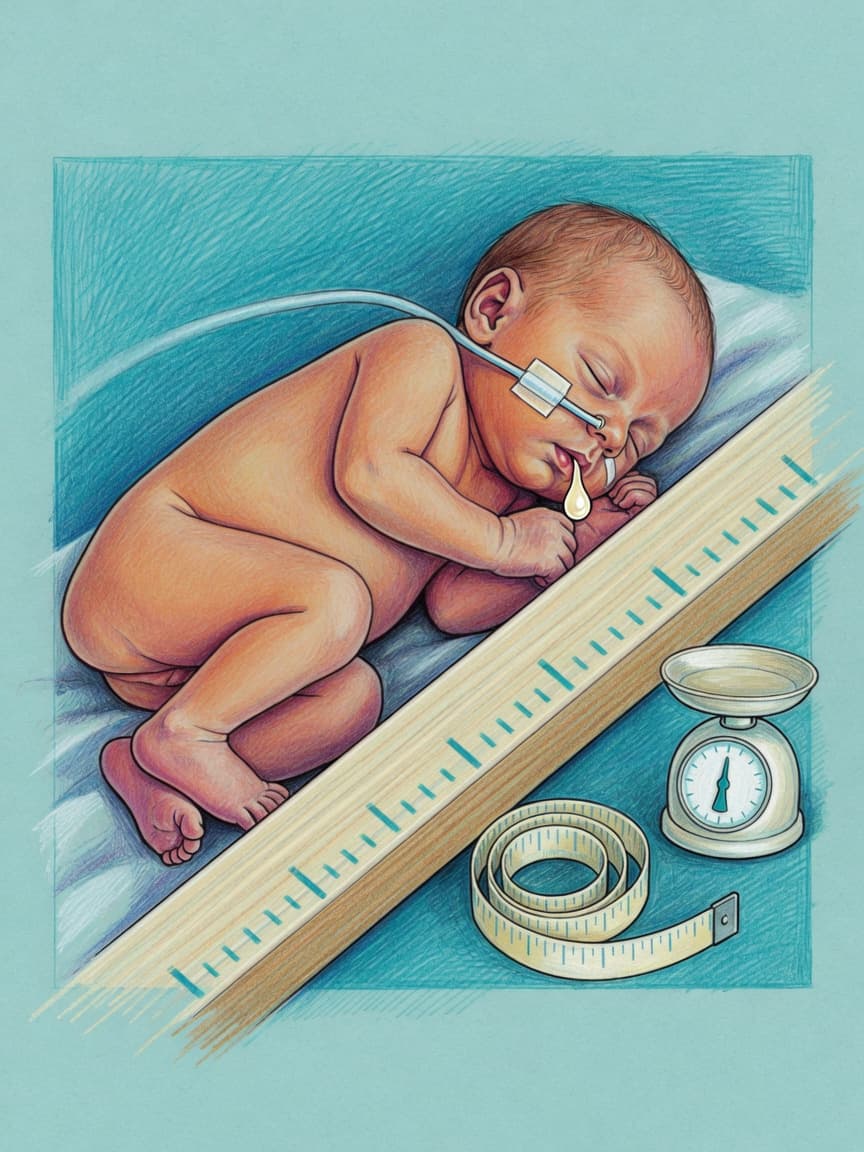
When a baby is born, the first thing the care team does is measure its weight, length, and head size and compare those numbers to other babies born at the same point in pregnancy. Two 2026 studies from the same research group rebuilt these comparison charts using modern methods and very large…
When a baby is born a few weeks early and the mother's own milk has not fully come in yet, the baby often needs a temporary top-up. A large, carefully blinded study from Australia tested whether that top-up should be donor human milk or infant formula, and found that the choice made no difference…
If your baby has spent time in a NICU, you've probably seen the growth chart. It hangs near the isolette, gets printed in weekly summaries, and comes up in nearly every conversation with the care team. Doctors and nurses plot your baby's weight, length, and head circumference on it regularly…
Babies born much too early, before 32 weeks of pregnancy, need very careful feeding while they grow in the neonatal intensive care unit, or NICU. Breast milk — either the mother's own milk or carefully screened donated milk from other mothers — is the recommended foundation for these babies. But…
If your baby is in a neonatal intensive care unit, you have probably seen a curved chart on a screen or on the wall, with a dot marking your baby's weight each day. That chart answers a deceptively simple question: is this baby growing the way we would hope? For a baby born early, the answer is…
If your baby was born premature and is in a neonatal intensive care unit (NICU), you have almost certainly seen the nurses weigh your baby every morning. That weight gets plotted on a chart — sometimes on paper, sometimes on a screen — that shows whether your baby is growing as expected.